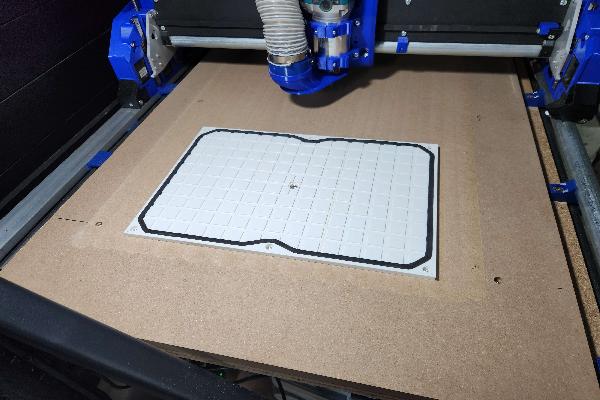
A CNC machine is basically a robot armed with a sharp spinning cutting tool. It is an integral part of the workflow in the Gobbo Lab because of how precisely it can cut shapes. This is especially useful as our projects often combine multiple mediums such as woodworking and 3D printing, and the precision from the CNC makes it much easier to design parts that consistently fit together. For example, the fortune teller and claw machine style dice towers you can see in the Project Archive all consist of hardwood outer shells attached to a 3D printed internal frame. The CNC is able to drill holes that align with the 3D printed parts to a much higher degree of accuracy than marking by hand or with a jig.
Our CNC was built by us in our shop using mostly a combination of 3D printed parts and commonly available electrical conduit. The design is specifically the Lowrider v4 from v1e.com. It is an excellent, robust, open machine with a wonderful community behind it.
One of the challenges to using a CNC is figuring out how you are going to secure your work piece to the table for cutting. All manner of clamps in different shapes and sizes exist for this but they all have one flaw. The thing about CNC machines, at least the maker tier home built ones like we run, is that they are fiercely loyal. They will execute whatever command you send them, regardless of what gets in the way or what they might need to light on fire. As such, clamps are always a persistent hazard just begging you to ram your brand new cutting tool into them and break it in half.
There are some big fancy solutions around this which actually use vacuum pressure to hold pieces to the table. There are almost no options for this at a consumer/maker level and the ones that do exist are still very expensive. (Especially for a tool you might ruin by crashing a cutter into. Ask how we know...) Looking at these systems, it did seem like someone could 3D print something very similar, at least on a small scale, and have the advantage of knowing that if (WHEN) you smashed it, that you could cheaply and easily print a replacement. This began our journey to developing our own freely available vacuum work holding system for CNC machines.
You can see more of the specifics, and download the files on Printables. The short version is that you have a small vacuum table on which you can place a foam gasket. Our system uses commonly available foam weather stripping. The work pieces sits on the gasket forming a seal, and a vacuum pump removes air from under the piece causing the weight of the air above to push down on top of the piece holding it in place. It is seriously impressive how much air actually weighs, creating a real sword in the stone moment trying to pull a piece off of active vacuum. The big advantage here is there are no clamps or other mechanical bits in the way for your machine to run into. The only major drawback is that you can't cut all the way though a piece, because as soon as you do you lose vacuum and thus your holding power.